How Did Rome Become So Powerful? The Real Reasons Behind the Empire

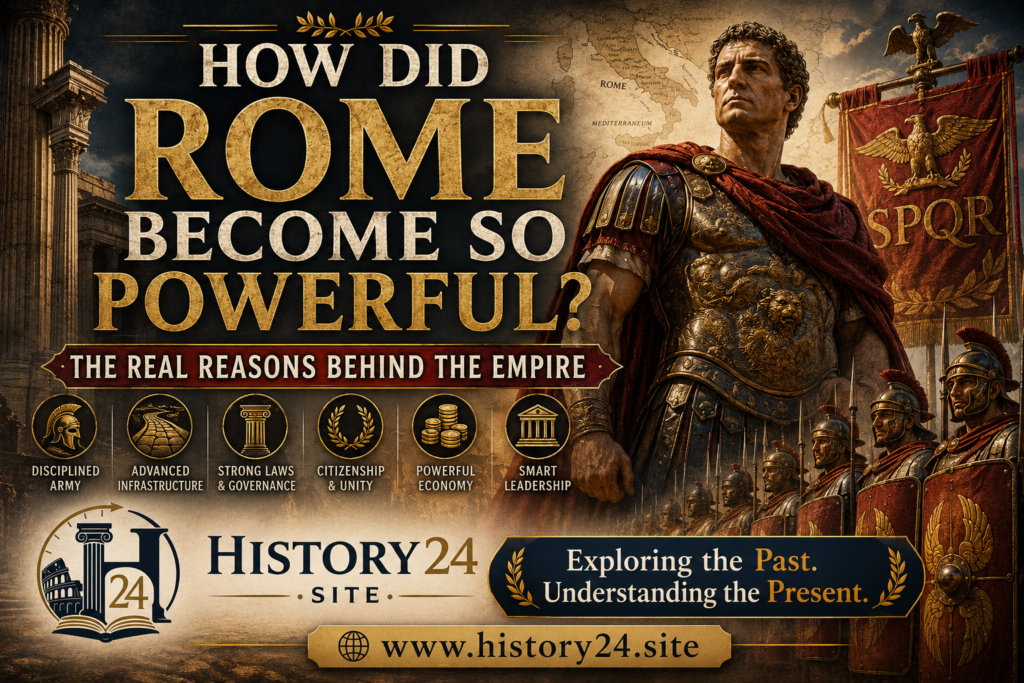
Rome started out as a small settlement on the Italian Peninsula. A few centuries later, it controlled territory stretching from Britain to the edge of Mesopotamia. That kind of growth doesn’t happen by accident, and it didn’t happen because Rome simply had the best soldiers.
Rome’s real advantage was that it never relied on just one strength. Military power, political flexibility, engineering, law, citizenship, and economics all reinforced each other. Pull on any one thread and you find the others holding it up. Here’s how that system actually worked.
A Military That Learned From Its Mistakes
The Roman legion is the part of this story most people already know: organized, disciplined, and capable of building fortified camps at the end of a day’s march. But the more interesting part is how often Rome lost, and what it did afterward.
The clearest example is the Second Punic War against Carthage. Hannibal crossed the Alps with war elephants and handed Rome a string of catastrophic defeats, including the disaster at Cannae in 216 BCE, where Rome lost tens of thousands of soldiers in a single day. A less resilient state might have collapsed. Rome rebuilt its army, changed its tactics, and eventually won the war and destroyed Carthage decades later in the Third Punic War. Losing a battle, or even losing an army, rarely meant losing the war with Rome.
Roads That Held the Empire Together
Conquering territory is one problem. Governing it is another, and Rome understood early that both required moving soldiers, officials, and supplies quickly and predictably.
The Roman road network eventually stretched for tens of thousands of miles, connecting cities, ports, and frontier garrisons. When a rebellion broke out or an enemy crossed a border, legions could reach the trouble faster than almost any other ancient army could respond to a threat. The same roads that moved soldiers also moved merchants, letters, and tax revenue, which made the empire easier to run day to day, not just easier to conquer.
Engineering That Solved Real Problems
Roman engineering gets remembered for its scale, but it was built to solve practical problems. Aqueducts carried fresh water into cities for drinking, public baths, and sanitation, which mattered enormously for keeping dense urban populations healthy. Roman concrete, made using volcanic ash, allowed builders to construct domes, harbors, and structures that still stand two thousand years later, including the dome of the Pantheon in Rome.
None of this was purely decorative. Fortified walls protected cities and military bases. Bridges kept supply lines open. Harbors kept trade moving. Roman engineering was infrastructure in service of the empire’s military and economic needs, not just an architectural flex.
Citizenship as a Political Strategy
One of Rome’s more unusual moves was treating citizenship as something that could expand rather than something reserved permanently for people born in the city of Rome. Communities across Italy, and eventually across the empire, could gain varying degrees of Roman legal status over time.
That culminated in 212 CE, when Emperor Caracalla issued the Constitutio Antoniniana, extending Roman citizenship to nearly every free person living within the empire’s borders. Citizenship came with real legal protections and a sense of shared identity that gave conquered populations a reason to invest in Rome’s success instead of quietly waiting for a chance to rebel.
Absorbing Conquered Peoples Instead of Erasing Them
Rome conquered a lot of people, but conquest didn’t automatically mean cultural destruction. Local languages, religions, and customs generally continued alongside Roman law and administration, and local elites were often folded into the Roman political system rather than pushed out of it.
Over generations, people born far from Italy could become Roman soldiers, senators, and eventually emperors. Trajan, one of Rome’s most successful emperors, came from a family in Hispania, not Italy. Septimius Severus, who ruled a century later, was born in North Africa. Rome’s willingness to promote provincial elites turned potential rivals into invested stakeholders in the empire’s success.
An Economy Built to Support an Empire
Running an empire is expensive. Soldiers need pay, equipment, and food. Cities need construction materials. Governments need tax revenue to function at all.
Rome controlled some of the most productive agricultural land in the ancient Mediterranean, and grain shipped from Egypt and North Africa fed the enormous population of the city of Rome itself, which may have reached close to a million people at its peak, an extraordinary size for a pre-industrial city. A standardized Roman currency made trade easier across provinces that had previously used entirely different coinage systems, and the Mediterranean Sea, which Romans called Mare Nostrum, or “our sea,” functioned as a cheap and efficient highway for moving goods between distant parts of the empire.
A Legal System That Outlasted the Empire Itself
Roman law developed over centuries into a genuinely sophisticated framework covering property, contracts, inheritance, and government. It wasn’t equal by modern standards, particularly for slaves and women, but it gave a huge and culturally diverse population a shared legal structure to operate within.
That legal tradition didn’t disappear when the empire did. Roman law heavily influenced the legal systems of many later European states, and traces of Roman legal concepts still show up in modern civil law today.
Alliances, Politics, and Ambitious Individuals
Rome didn’t expand purely through conquest. Alliances with neighboring communities, who often provided soldiers or supplies in exchange for protection or political favor, extended Rome’s reach well beyond what its own citizens could have achieved alone.
Ambitious individuals mattered too. Julius Caesar’s conquest of Gaul between 58 and 50 BCE built his military reputation and his political power, and his eventual crossing of the Rubicon River in 49 BCE triggered a civil war that ended the Roman Republic in all but name. After years of conflict, his adopted heir Augustus emerged as sole ruler in 27 BCE and established the imperial system that would govern Rome for the next four centuries.
How Big Did Rome Actually Get?
The empire reached its largest territorial extent under Emperor Trajan in 117 CE, stretching from Britain in the northwest to Mesopotamia in the east, and from the Rhine and Danube frontiers down into North Africa. Governing a territory that size, with the road, communication, and administrative systems available at the time, was as much an achievement as conquering it in the first place.
The Real Answer
There’s no single reason Rome became so powerful. It wasn’t the army alone, or the roads alone, or the law alone. It was all of these working together as one system: soldiers who could move fast because of roads, cities that stayed healthy because of aqueducts, provinces that stayed loyal because of citizenship, and an economy strong enough to pay for all of it.
