John F. Kennedy: The Full Story of America’s 35th President

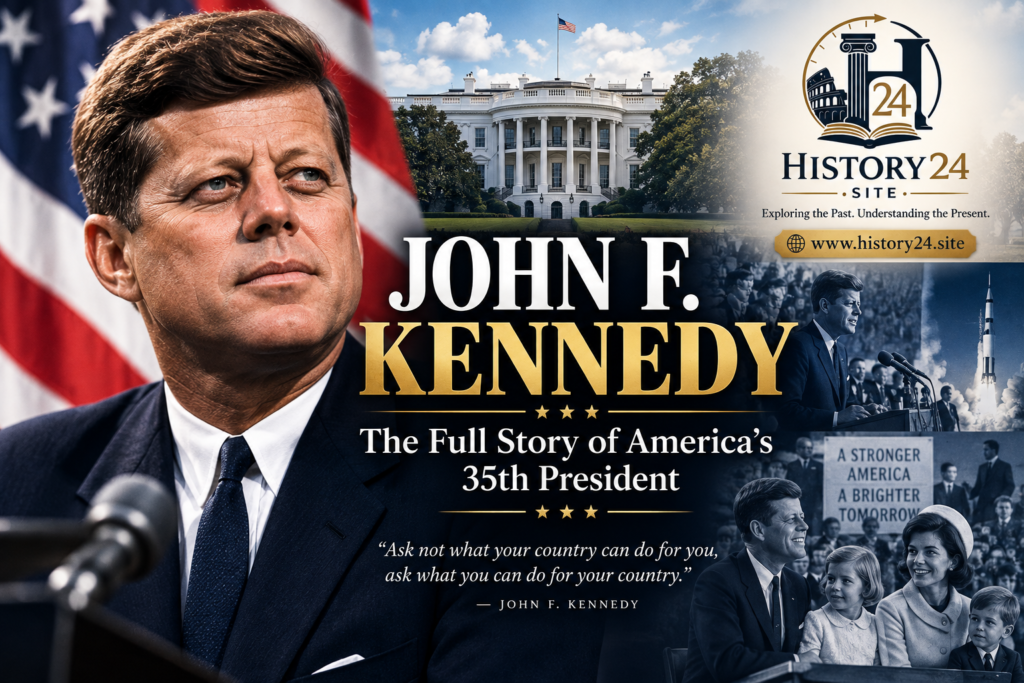
John F. Kennedy served as president for barely a thousand days, and yet few American leaders have left a bigger mark on how the country sees itself. He took office at 43, promising a “new generation” of leadership, and left it at 46, shot dead in a Dallas motorcade. In between came a nuclear standoff with the Soviet Union, a botched invasion of Cuba, a promise to put a man on the Moon, and a slow, reluctant turn toward supporting civil rights.
This is his story, from a sickly childhood in Massachusetts to a presidency that ended in Dealey Plaza — and a legacy that’s still argued over more than sixty years later.
John F. Kennedy at a Glance
| Full name | John Fitzgerald Kennedy |
| Born | May 29, 1917, Brookline, Massachusetts |
| Died | November 22, 1963, Dallas, Texas (age 46) |
| Party | Democratic |
| Spouse | Jacqueline Bouvier Kennedy |
| Vice President | Lyndon B. Johnson |
| Term | January 20, 1961 – November 22, 1963 |
| Military service | U.S. Navy, commander of PT-109 |
| Defining crisis | Cuban Missile Crisis, October 1962 |
A Kennedy Childhood in Massachusetts
Kennedy was born into money and ambition. His father, Joseph P. Kennedy Sr., was a businessman turned diplomat who served as U.S. ambassador to the United Kingdom, and his mother, Rose Fitzgerald Kennedy, was the daughter of a Boston mayor. John — known to the family as Jack — was the second of nine children, and growing up in that household meant constant competition. Joseph Sr. expected his children to win, at everything, and he wasn’t shy about saying so.
Jack wasn’t the healthiest of the bunch. He was in and out of illness for most of his childhood, and that pattern of hidden health struggles would follow him for the rest of his life. What the public eventually saw was a confident, energetic young politician. What his family and doctors saw was something more fragile.
Harvard and Why England Slept
Kennedy studied government at Harvard, and his senior thesis — an analysis of why Britain was so unprepared for Nazi Germany’s rise — became his first published book, Why England Slept. It sold well and gave him an early reputation as a serious thinker on foreign policy, which mattered later when voters had to decide whether a 43-year-old was ready to handle the Cold War.
PT-109 and the War That Made Him a Hero
Kennedy joined the Navy in 1941 despite his health problems, and by 1943 he was commanding a patrol torpedo boat, PT-109, in the Solomon Islands. On the night of August 1–2, 1943, a Japanese destroyer, the Amagiri, rammed the boat and split it in half, killing two of his crew.
Kennedy and the survivors swam for nearby islands. At one point he towed a badly burned crewman for hours, gripping a strap of the man’s life jacket in his teeth. After days without rescue, Kennedy swam out alone searching for help and eventually got a message to Allied forces carved into a coconut shell. The crew was rescued, and Kennedy came home with the Navy and Marine Corps Medal and a Purple Heart for the injuries he suffered.
The PT-109 story became a permanent part of his political identity — proof, to voters, that the young senator running for president had already been tested under fire.
From War Hero to Politician
Kennedy’s older brother, Joseph Jr., had been the one groomed for a political career. When Joseph Jr. was killed in action in 1944, the family’s expectations shifted to John, and he didn’t waste time. In 1946 he won a seat in the U.S. House of Representatives from Massachusetts, serving from 1947 to 1953 and building a reputation on both domestic and foreign policy.
In 1952 he took a bigger swing, challenging incumbent Republican Senator Henry Cabot Lodge Jr. He won, and by January 1953 he was a U.S. senator with a growing national profile.
Profiles in Courage and a Pulitzer
While recovering from back surgery, Kennedy wrote Profiles in Courage, a book about senators who had risked their careers to do what they believed was right. Published in 1956, it became a bestseller and won the Pulitzer Prize for Biography in 1957. It also did something more useful to Kennedy than any speech could have: it made him look presidential.
Marrying Jackie Bouvier
In 1953, Kennedy married Jacqueline Bouvier, a Washington photographer from a wealthy, socially connected family. Jackie was fluent in French, deeply interested in art and history, and far more than the decorative first lady some expected. The couple had two children who survived infancy, Caroline (born 1957) and John Jr. (born 1960) — though their family also endured devastating losses. A daughter, Arabella, was stillborn in 1956, and their infant son Patrick died just two days after being born prematurely in August 1963, only months before Kennedy’s own death.
Jackie’s poise and style became inseparable from the Kennedy political brand, and as first lady she led an effort to restore the White House’s historic interiors, turning it into something closer to a living museum of American history.
The 1960 Election: Kennedy vs. Nixon
By 1960, Kennedy was ready to run for the top job, and he picked Texas power broker Lyndon B. Johnson as his running mate to shore up Southern support. His opponent was sitting Vice President Richard Nixon, and the race turned into one of the closest and most-watched elections in American history, partly because of the first televised presidential debates, where Kennedy’s calm, camera-friendly presence gave him an edge over a visibly uncomfortable Nixon.
Kennedy won narrowly, becoming both the youngest person ever elected president and the first Roman Catholic to hold the office.
Taking Office in the Middle of the Cold War
Kennedy was sworn in on January 20, 1961, delivering an inaugural address remembered for one line above all: his call for Americans to ask what they could do for their country. He inherited a world split between two nuclear superpowers, and that reality would define almost everything he did in office.
The New Frontier
Kennedy branded his domestic agenda the New Frontier, pushing for progress on education, healthcare, civil rights, and space exploration. Congress, however, was not cooperative — conservative Democrats and Republicans blocked much of it, and a good deal of what people now associate with Kennedy’s presidency, including major civil rights legislation, only became law after his death, under Lyndon Johnson.
The Bay of Pigs Disaster
Kennedy’s first real foreign policy test came just months into his presidency. In April 1961, a CIA-trained force of Cuban exiles landed at the Bay of Pigs, intending to topple Fidel Castro. It fell apart almost immediately, and Kennedy publicly took responsibility for the failure. The episode made him warier of blindly trusting military and intelligence advice — a lesson that mattered enormously the following year.
Racing the Soviets to the Moon
The Soviets were winning the space race early on, having already launched Sputnik and sent Yuri Gagarin into orbit. In May 1961, Kennedy answered with one of the boldest promises any American president has made: landing a man on the Moon and bringing him home safely before the decade was out. He didn’t live to see it happen, but in July 1969, Apollo 11 delivered on his challenge.
Launching the Peace Corps
Kennedy created the Peace Corps by executive order on March 1, 1961, sending American volunteers abroad to work on education, agriculture, and public health in developing communities. Of everything from his presidency, it’s one of the few programs that still operates largely as he designed it.
Thirteen Days in October: The Cuban Missile Crisis
In October 1962, American reconnaissance photos revealed Soviet nuclear missile sites under construction in Cuba, just 90 miles from Florida. What followed was thirteen days that came closer to nuclear war than anything before or since.
Kennedy rejected calls for an immediate invasion and instead ordered a naval quarantine around Cuba to block further Soviet shipments, while demanding the missiles already there be removed. Soviet leader Nikita Khrushchev eventually agreed. Publicly, the U.S. promised not to invade Cuba; privately, it also agreed to quietly withdraw its own Jupiter missiles from Turkey. The crisis ended without a shot fired between the two superpowers, and it reshaped how Kennedy approached the rest of the Cold War.
Cooling the Cold War
By 1963, Kennedy was actively looking for ways to lower the temperature with Moscow. In a June speech at American University, he called for a fundamental rethinking of U.S.-Soviet relations. That same year, the two countries signed the Limited Nuclear Test Ban Treaty, banning nuclear tests in the atmosphere, in space, and underwater, and Kennedy backed the creation of the Washington-Moscow hotline so future crises wouldn’t have to rely on slow diplomatic cables.
Kennedy and the Civil Rights Movement
Kennedy came to civil rights slowly. Early in his presidency he avoided pushing hard, worried about alienating Southern Democrats he needed for other legislation. Events eventually forced his hand: violent attacks on Freedom Riders, the crisis over integrating the University of Mississippi, and the brutal police response to protesters in Birmingham, all broadcast on national television, shifted public opinion fast.
In June 1963, Kennedy gave a televised address framing civil rights as a moral issue, not just a legal one, and sent Congress a sweeping civil rights bill. He was killed before it passed. Lyndon Johnson pushed it through in his place, and it became the Civil Rights Act of 1964 — one of the most consequential laws in American history, built on groundwork Kennedy had laid just months before his death.
The Speeches People Still Quote
Kennedy was a genuinely gifted speaker, and a handful of his speeches are still studied today: his 1961 inaugural address, his 1962 address explaining the Cuban Missile Crisis to a frightened public, his 1963 American University speech on peace, his June 1963 civil rights address, and his 1963 “Ich bin ein Berliner” speech in West Berlin, delivered to a crowd desperate for a sign that the West hadn’t forgotten them. The JFK Presidential Library holds recordings and transcripts of all of them.
The Health Problems Hidden From the Public
Kennedy’s energetic public image masked a lifetime of serious illness. He suffered from chronic back pain severe enough to require multiple surgeries, and he lived with Addison’s disease, a hormonal disorder that his campaign and White House staff went to considerable lengths to keep out of the press. In an era when a president was expected to project total physical command in the face of nuclear threats, revealing that vulnerability wasn’t politically possible — so it stayed hidden until long after his death.
November 22, 1963: The Assassination
Kennedy traveled to Dallas on a political trip, riding through downtown in an open motorcade with Jackie and Texas Governor John Connally. At around 12:30 p.m., shots rang out as the motorcade passed through Dealey Plaza. Kennedy was hit and rushed to Parkland Memorial Hospital, where doctors could not save him. He was pronounced dead shortly afterward, at 46 years old.
Lyndon Johnson was sworn in as president that same afternoon, aboard Air Force One, with Jackie Kennedy — still in her blood-stained clothing — standing beside him.
Oswald, Ruby, and the Questions That Never Went Away
Lee Harvey Oswald was arrested within hours, charged with killing both Kennedy and Dallas police officer J.D. Tippit. Two days later, Oswald himself was shot dead by nightclub owner Jack Ruby while being transferred through the Dallas police station, live on television.
Because Oswald never stood trial, the case never got the kind of closure a courtroom might have provided. The Warren Commission, set up by President Johnson, concluded Oswald acted alone, but the assassination has generated six decades of competing theories, congressional re-investigations, and document releases, some still ongoing through the National Archives.
A Nation in Mourning
Kennedy’s funeral took place in Washington on November 25, 1963, drawing world leaders and an enormous television audience. He was buried at Arlington National Cemetery, where an eternal flame still marks his grave — one of the most recognized memorials in the country.
What Kennedy Left Behind
Kennedy’s legacy is more complicated than the myth around it. His handling of the Cuban Missile Crisis is still taught as a model of careful, restrained crisis management, and his push for arms control reshaped how the U.S. and Soviet Union dealt with each other afterward. His space program challenge delivered the Moon landing six years after his death. His civil rights address and proposed legislation gave Johnson the political opening to pass the 1964 Civil Rights Act. And the Peace Corps, decades later, is still sending volunteers abroad.
At the same time, historians point to real failures: the Bay of Pigs, an escalating and unresolved situation in Vietnam, and a domestic agenda that stalled in Congress for most of his term.
Much of Kennedy’s enduring fame also comes from something less tangible than policy. Weeks after his death, Jackie Kennedy gave an interview invoking Camelot, the mythical court of King Arthur, to describe her husband’s presidency — and the label stuck. It helped cement an image of youth, glamour, and unfinished promise that has shaped how Americans remember him ever since, sometimes more than the actual record of his three years in office.
John F. Kennedy Timeline
- 1917 — Born in Brookline, Massachusetts
- 1940 — Graduates from Harvard
- 1943 — PT-109 is sunk; Kennedy leads survivors to safety
- 1946 — Elected to the U.S. House of Representatives
- 1952 — Elected to the U.S. Senate
- 1953 — Marries Jacqueline Bouvier
- 1957 — Wins the Pulitzer Prize for Profiles in Courage
- 1960 — Elected the 35th president of the United States
- 1961 — Bay of Pigs invasion fails; Peace Corps founded; Moon goal announced
- 1962 — Cuban Missile Crisis
- 1963 — Civil rights address; Limited Nuclear Test Ban Treaty signed; assassinated in Dallas on November 22
- 1964 — Civil Rights Act signed into law under Lyndon Johnson
- 1969 — Apollo 11 fulfills Kennedy’s Moon landing pledge
Conclusion
Kennedy’s presidency lasted barely three years, but few American leaders have been examined this closely for this long. He came into office promising a new generation of leadership and left behind a record that’s genuinely mixed: a foreign policy disaster in Cuba followed months later by his finest hour handling the missile crisis there, a civil rights bill he introduced but didn’t live to sign, and a Moon landing he set in motion but never saw.
More than sixty years after Dallas, Kennedy remains one of the most written-about figures in American history, not just for what he accomplished, but for how much was left unfinished when it all ended.
Abraham Lincoln: From Humble Beginnings to an Enduring Legacy
References
