The 10 Most Powerful Empires in Ancient History

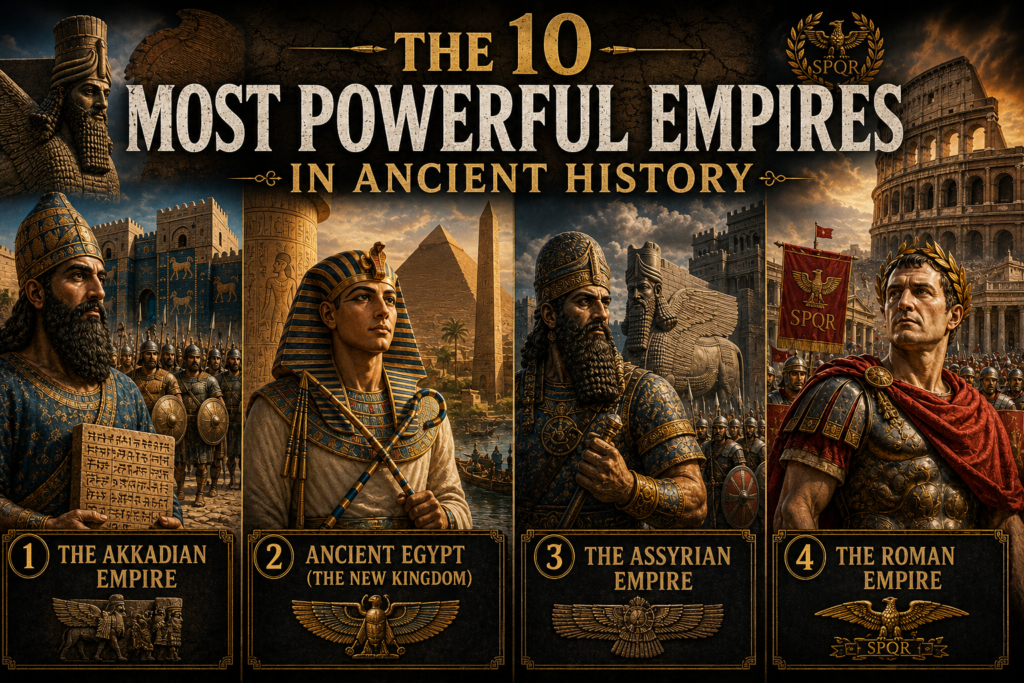
Empires are strange things. They start as a single city, a single tribe, or a single ambitious ruler with an army and a grudge, and somehow end up controlling millions of people who never asked to be ruled. Ancient history is full of these stories, and a handful of them grew so large, so wealthy, or so influential that we are still talking about them thousands of years later.
This list looks at ten of the most powerful empires in ancient history, chosen for a mix of territorial reach, military strength, economic weight, and lasting cultural influence. Some lasted centuries. Others burned bright and collapsed within a few generations. All of them left a mark on the world that followed.
1. The Akkadian Empire
The Akkadian Empire, founded by Sargon of Akkad around 2334 BCE, is often credited as the world’s first true empire. Before Sargon, Mesopotamia was a patchwork of independent city-states like Ur, Uruk, and Lagash, each with its own king and its own squabbles. Sargon changed that by conquering the Sumerian city-states and unifying them under a single administration based in the city of Akkad.
What made this genuinely new wasn’t just the size of the territory, it was the idea of ruling over different peoples and cities as one connected state rather than a loose collection of conquests. Akkadian became a shared administrative language across Mesopotamia, and Sargon’s dynasty set a template that later Mesopotamian rulers would copy for the next two thousand years. The empire didn’t last much more than a century and a half, but its influence on how kingship and statecraft worked in the ancient Near East was enormous.
2. Ancient Egypt (The New Kingdom)
Egypt had already been a powerful, unified kingdom for well over a thousand years by the time it entered its most expansionist phase, the New Kingdom, starting around 1550 BCE. This is the Egypt most people picture when they think of pharaohs: Hatshepsut, Thutmose III, Akhenaten, and Ramesses II all ruled during this period.
Thutmose III pushed Egyptian control deep into the Levant and Nubia, and for a time Egypt sat at the center of a trade and diplomatic network that stretched from Anatolia to sub-Saharan Africa. Egyptian gold, grain, and manufactured goods moved through this network, and Egyptian temples and monuments absorbed a share of that wealth, which is why so much of what survives from this era is so visually spectacular. The New Kingdom eventually declined under pressure from the mysterious Sea Peoples and internal fragmentation, but for roughly five centuries, Egypt was one of the wealthiest and most stable powers on earth.
The Darkest Secrets Hidden Inside Ancient Egypt
3. The Assyrian Empire
If Egypt built its power on stability and monuments, Assyria built its power on fear and logistics. The Neo-Assyrian Empire, which peaked between roughly 900 and 612 BCE, was arguably the first empire to run on genuinely industrial-scale warfare. Assyrian kings like Tiglath-Pileser III and Ashurbanipal fielded professional standing armies, built an extensive road network, and used a relay messenger system to move information and orders across their territory faster than any prior state had managed.
Assyria controlled Mesopotamia, the Levant, and at its height even Egypt itself. It also pioneered mass deportation as a tool of control, relocating conquered populations to break local resistance and disrupt rebellions before they started. Ashurbanipal’s library at Nineveh, containing thousands of cuneiform tablets, is one of the reasons we know as much as we do about Mesopotamian literature and mythology today. The empire’s brutal reputation eventually caught up with it, and a coalition of Babylonians and Medes destroyed Nineveh in 612 BCE, ending Assyrian dominance for good.
4. The Neo-Babylonian Empire
Babylon’s second great moment came after it helped bring down Assyria. Under Nebuchadnezzar II, who ruled from 605 to 562 BCE, the Neo-Babylonian Empire took over much of Assyria’s former territory and turned Babylon itself into arguably the largest and most impressive city in the world at that time.
Nebuchadnezzar is best known outside academic circles for the biblical account of his conquest of Jerusalem and the exile of the Judean population, an event that shaped Jewish history and religious thought for centuries afterward. Within Babylon, his building projects included massive city walls, temple restorations, and, according to later Greek writers, the Hanging Gardens, though modern historians still debate whether that structure was actually in Babylon or somewhere else entirely. The empire didn’t outlast Nebuchadnezzar by much, falling to the Persians under Cyrus the Great in 539 BCE.
5. The Achaemenid Persian Empire
Cyrus the Great didn’t just conquer Babylon, he built the largest empire the world had yet seen. At its peak under Darius I and Xerxes I, the Achaemenid Empire stretched from the Balkans and Egypt in the west to the Indus Valley in the east, ruling over an estimated 40 to 50 million people, a huge share of the world’s population at the time.
What set Persia apart was administration rather than sheer conquest. The empire was divided into provinces called satrapies, each run by a governor but connected by a standardized system of roads, weights, and currency, along with an efficient postal relay that later inspired comparisons to the Pony Express. Persia also allowed conquered peoples a surprising degree of religious and cultural autonomy, which is part of why Cyrus is remembered so favorably in sources like the Hebrew Bible. The empire’s long rivalry with the Greek city-states, especially the wars against Athens and Sparta, is one of the most heavily documented conflicts of the ancient world. Persia eventually fell to Alexander the Great in 330 BCE.
6. The Macedonian Empire of Alexander the Great
Few empires in history were built as fast, or collapsed as fast, as Alexander’s. In just over a decade, from 336 to 323 BCE, Alexander led Macedonian and Greek forces across the entire former Persian Empire, then pushed further into Central Asia and eventually northwest India before his troops finally refused to go any farther.
Alexander’s conquests didn’t just redraw borders, they kicked off the Hellenistic era, a period where Greek language, art, and philosophy spread across the Middle East and blended with local traditions in Egypt, Persia, and beyond. Cities he founded or renamed, most famously Alexandria in Egypt, became centers of learning and trade for centuries. The empire itself didn’t survive his death in 323 BCE at age 32. His generals, known as the Diadochi, carved it into rival successor kingdoms, but the cultural fusion he set in motion outlived his political project by a long stretch.
7. The Maurya Empire
In South Asia, the Maurya Empire brought together most of the Indian subcontinent under a single ruler for the first time. Founded by Chandragupta Maurya around 321 BCE, the empire reached its greatest extent under his grandson Ashoka, who controlled territory stretching from modern Afghanistan to nearly the southern tip of India.
Ashoka’s story is one of the more striking turns in ancient history. After a brutally violent conquest of the Kalinga region, he reportedly experienced a deep change of heart, converted to Buddhism, and spent the rest of his reign promoting nonviolence, religious tolerance, and public welfare projects like roads, wells, and hospitals. His edicts, carved into pillars and rocks across the empire, are among the earliest surviving examples of a ruler publicly committing to ethical governance. The Mauryan bureaucracy, with its detailed taxation and record-keeping systems, also influenced how later Indian states were organized long after the empire itself dissolved in the early 2nd century BCE.
8. The Qin and Han Dynasties of China
China’s first empire was short and brutal, its second was long and transformative. The Qin dynasty, founded by Qin Shi Huang in 221 BCE, unified the warring Chinese states through sheer military force and standardized writing, currency, and measurements across the new territory. It’s also responsible for the early stages of the Great Wall and the enormous Terracotta Army buried alongside the first emperor. The Qin collapsed within about fifteen years of his death, worn down by harsh laws and forced labor projects.
The Han dynasty that followed, ruling from 206 BCE to 220 CE with a brief interruption, is where Chinese imperial power really matured. The Han expanded China’s borders, formalized Confucian principles as the basis of state administration, and opened the trade routes that would later be called the Silk Road, connecting China to Central Asia, Persia, and eventually Rome. Han China developed paper, advanced ironworking, and a civil service exam system that, in modified forms, influenced Chinese governance for the next two thousand years.
9. The Parthian Empire
Persia’s imperial tradition didn’t end with Alexander’s conquest, it eventually reasserted itself through the Parthians. Rising out of the Hellenistic successor states in the mid-3rd century BCE, the Parthian Empire came to control Iran, Mesopotamia, and much of the Silk Road’s western terminus by the 1st century BCE.
Parthia is best remembered today as Rome’s most persistent eastern rival. Roman armies repeatedly tried and failed to subdue Parthian territory, most famously at the Battle of Carrhae in 53 BCE, where Parthian horse archers and heavy cavalry destroyed a Roman force led by Crassus, one of the richest men in Roman history. The Parthians controlled a key stretch of the trade routes linking Rome and China, taxing goods that passed through their territory and profiting handsomely from a trade network they never had to fully control on either end. The empire eventually gave way to the Sasanian Persians in 224 CE.
10. The Roman Empire
No list of ancient empires is complete without Rome, and for good reason. What began as a single city-state on the Italian peninsula grew, through the Republic and then the Empire proper starting with Augustus in 27 BCE, into a state that controlled the entire Mediterranean basin along with large parts of Europe, North Africa, and the Middle East.
Rome’s staying power came from a combination of military organization, engineering, and legal infrastructure that few empires before or since have matched. Roman roads, aqueducts, and cities connected an enormous and diverse population, while Roman law and citizenship provided a framework that could absorb conquered peoples rather than simply ruling over them by force. Latin became the administrative and literary language across the western part of the empire, shaping the Romance languages that developed centuries later. Rome’s western half finally collapsed in 476 CE, but its eastern half, which we now call the Byzantine Empire, carried Roman institutions and law forward for another thousand years.
What Made These Empires So Powerful
Looking at these ten side by side, a few patterns stand out. The empires that lasted longest, Persia, Rome, and Han China among them, tended to succeed through administration as much as conquest, building road networks, standardized systems, and some level of tolerance for local customs. The ones that leaned hardest on pure military force, like Assyria and the Qin dynasty, tended to burn out fast even when they were terrifyingly effective in the short term.
| Empire | Approximate Peak | Known For |
|---|---|---|
| Akkadian | 2334–2154 BCE | First true multi-city empire |
| Egyptian New Kingdom | 1550–1077 BCE | Monumental building, regional trade power |
| Assyrian | 900–612 BCE | Military logistics, mass deportation policy |
| Neo-Babylonian | 626–539 BCE | Monumental Babylon, conquest of Judah |
| Achaemenid Persian | 550–330 BCE | Largest empire of its time, road and postal systems |
| Macedonian (Alexander) | 336–323 BCE | Rapid conquest, spread of Hellenistic culture |
| Maurya | 321–185 BCE | Unified South Asia, Ashoka’s edicts |
| Qin and Han China | 221 BCE–220 CE | Unification, Silk Road, civil administration |
| Parthian | 247 BCE–224 CE | Rome’s eastern rival, Silk Road trade control |
| Roman | 27 BCE–476 CE (West) | Law, engineering, and long-term institutional stability |
What ties all ten of these empires together is that none of them were inevitable. Each depended on a specific ruler, a specific military innovation, or a specific stretch of good luck at the right moment. Studying them side by side says less about any single culture being destined for greatness and more about how fragile and improvised even the mightiest ancient states really were.
References
https://www.worldhistory.org/egypt
