10 Historical Photos That Changed the World Forever

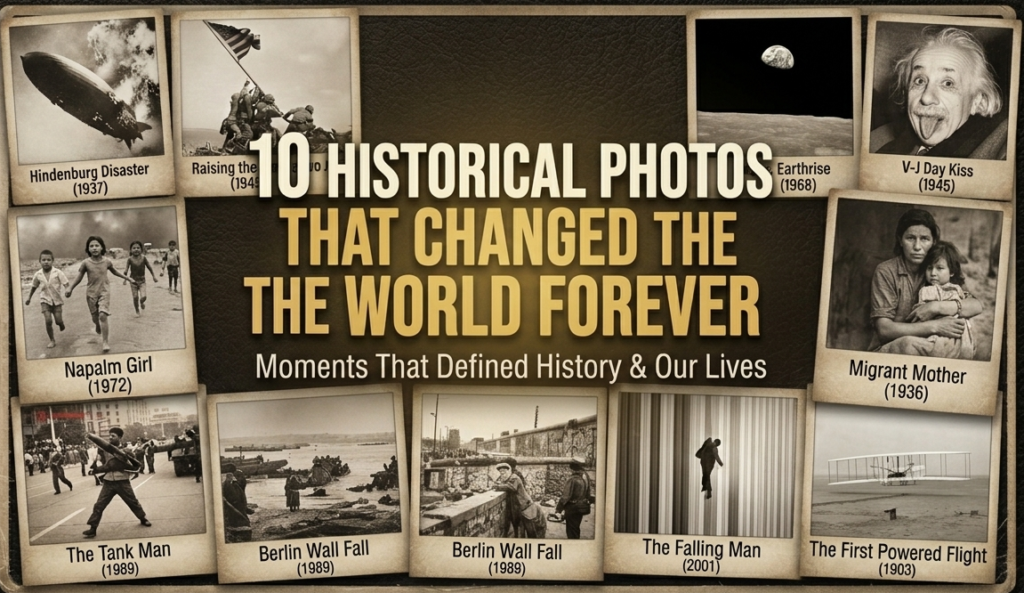
Some moments don’t need a paragraph. A single photograph does the job better, freezing a second in time that words alone could never quite capture. Here are ten of them, spanning war, space, protest, and grief, that ended up shaping how we remember the century behind us.
1. The Hindenburg Disaster (1937)
The German airship Hindenburg was attempting to land in Lakehurst, New Jersey, when it burst into flames in front of a crowd of onlookers and news cameras. The photograph of the fireball is still one of the most recognizable disaster images ever taken, and it effectively ended the age of passenger airships. Within a few years, the future of long-distance travel belonged to airplanes instead.

2. Raising the Flag on Iwo Jima (1945)
Joe Rosenthal’s photo of six Marines raising the American flag atop Mount Suribachi during World War II wasn’t staged, though people have argued about that for decades (it was actually the second flag raised that day, after a smaller one went up earlier). It went on to win the Pulitzer Prize and became the basis for the Marine Corps War Memorial in Arlington.
3. V-J Day Kiss in Times Square (1945)
When news broke that Japan had surrendered, a sailor kissed a nurse in the middle of Times Square, and photographer Alfred Eisenstaedt happened to catch it. The identities of the two people in the photo weren’t confirmed for decades, and more recent conversations about the photo have raised uncomfortable questions about consent in that split-second moment. It’s complicated. It’s also still one of the most reproduced photographs of the 20th century.
4. Earthrise (1968)
Astronauts aboard Apollo 8 were orbiting the moon, photographing its surface, when they turned around and saw Earth rising over the lunar horizon. Nobody had planned for that shot. It’s often credited with helping kick off the modern environmental movement, since it was the first time most people had ever really seen how small and fragile the planet looked from a distance.
5. The Tank Man (1989)
The day after Chinese troops cleared Tiananmen Square, one man stood in front of a column of tanks and refused to move. No one knows his name. No one knows what happened to him afterward. The photo has outlived the mystery, becoming shorthand for a single person standing up to overwhelming force.
6. The Falling Man (2001)
Photographer Richard Drew captured a man falling from the North Tower during the September 11 attacks. Newspapers that ran it faced backlash almost immediately, and many outlets pulled it after a single printing. It remains one of the most disturbing and disputed images from that day, exactly because it shows a choice no one should ever have had to make.
7. The Napalm Girl (1972)
Nick Ut’s photo of nine-year-old Phan Thi Kim Phúc, running down a road after a napalm attack during the Vietnam War, is credited by many historians with shifting American public opinion against the war. Kim Phúc survived her injuries, later became a Canadian citizen, and has spent much of her adult life advocating for war victims. Ut reportedly drove her to a hospital himself after taking the photo.
8. Migrant Mother (1936)
Dorothea Lange took this portrait of Florence Owens Thompson at a pea-pickers’ camp in California during the Great Depression. Thompson, a mother of seven, had just sold her car tires for food. The photo was used to secure federal aid for the camp within days of being published, a rare case of a single image producing an almost immediate, tangible result.
9. Earth from Apollo 17 — The Blue Marble (1972)
This was the first photograph to show Earth fully lit, with no shadow across it, taken by the crew on their way to the moon. It’s since become one of the most reproduced images ever taken, showing up on everything from textbooks to protest signs. There’s something almost unsettling about how ordinary the planet looks in it — just a blue marble hanging in the dark.
10. The First Powered Flight (1903)
John T. Daniels, a member of the Kill Devil Hills lifesaving crew, snapped the shutter at the exact moment the Wright Flyer left the ground — a flight that lasted all of 12 seconds and covered about 120 feet. He’d never used a camera before that day. Without that one frame, we might not have solid proof of exactly when powered flight began.
Photographs like these don’t just document history, they occasionally reshape it. A single frame pushed public opinion against a war, secured emergency aid, or gave a faceless act of courage a permanent symbol. Books can tell you what happened. Sometimes a photo is the only thing that lets you feel it.