Top 10 Revolutionary Inventions That Shaped Human History

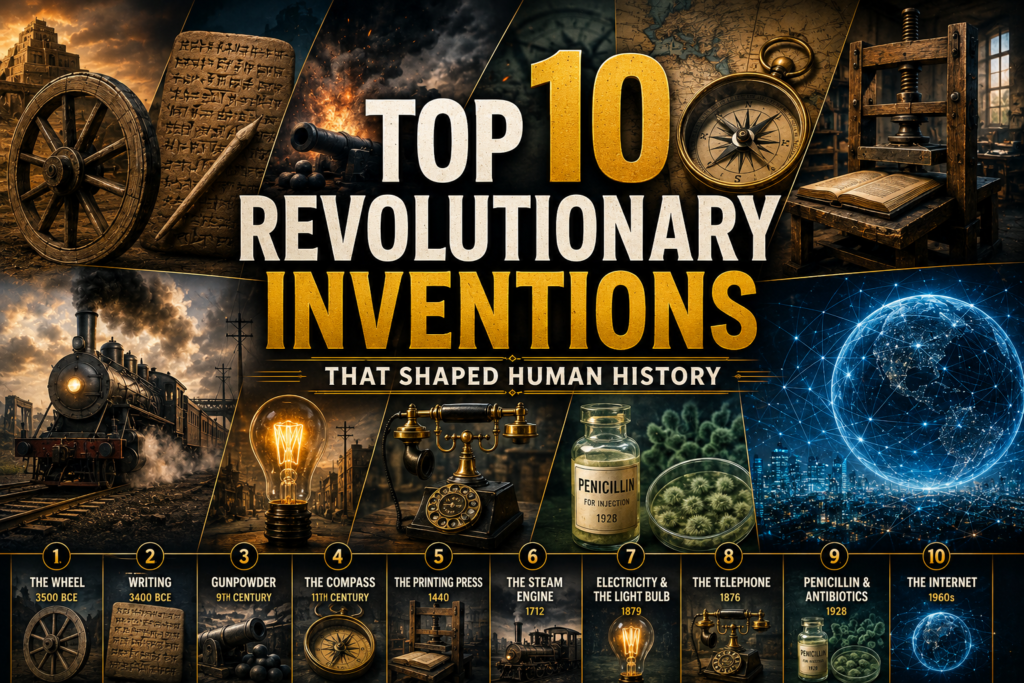
Most of human history can be told through the things people built to solve a problem. Somebody got tired of carrying heavy loads and invented the wheel. Somebody got tired of copying manuscripts by hand and built a printing press. Somebody got tired of dying from infections and discovered penicillin. Each of these moments looks small in isolation, but stacked together, they’re the reason daily life today looks nothing like it did a thousand, or even a hundred, years ago.
Here are ten inventions that didn’t just improve on what came before them. They changed the direction of human history entirely.
1. The Wheel
The wheel first appeared in Mesopotamia around 3500 BCE, and it’s easy to take for granted precisely because it’s everywhere. Before it existed, moving anything heavy meant dragging it, and dragging it meant limits on how far people could travel, trade, or build.
Once wheeled carts entered the picture, trade routes expanded, cities grew because materials could be moved in from farther away, and entire industries around transportation began to form. Every car, train, and airplane wheel spinning today traces its lineage back to that first Mesopotamian breakthrough.
2. Writing
Writing emerged in Sumer around 3400 BCE in the form of cuneiform, wedge-shaped marks pressed into clay tablets. It started out as a practical tool for tracking grain shipments and tax records, not literature or philosophy.
But once information could be recorded and passed down instead of relying purely on memory, everything changed. Law codes could be written and enforced consistently. Knowledge could outlive the person who discovered it. Writing is arguably the single invention that made the rest of recorded history possible in the first place.
3. Gunpowder
Gunpowder was developed in China during the 9th century, originally by alchemists searching for something else entirely, a potential elixir for immortality. Instead, they found a mixture that exploded.
It took a few centuries for gunpowder to reshape warfare, but once it did, castles stopped being safe, cavalry charges stopped being decisive, and the balance of military power shifted toward whoever had the better firearms and cannons. Gunpowder didn’t just change how wars were fought. It changed which empires could realistically stay in power.
4. The Compass
The magnetic compass also has Chinese origins, first used for divination purposes as early as the 2nd century BCE before it was adapted for navigation by around the 11th century. Sailors no longer had to hug coastlines or rely purely on the stars to know which direction they were heading.
That single tool made long-distance ocean travel far more reliable, which in turn made the Age of Exploration possible. Without a dependable way to find north at sea, the maps of the world we recognize today might have taken centuries longer to fill in.
5. The Printing Press
Johannes Gutenberg introduced the movable-type printing press in Germany around 1440. Before this, books were copied by hand, one at a time, which meant they were rare and expensive, and literacy was largely limited to the wealthy and the religious elite.
The printing press made books fast and cheap to produce. Ideas that once spread slowly, if at all, could now travel across an entire continent within a generation. It’s not an exaggeration to say the printing press helped fuel the Renaissance, the Reformation, and eventually the Scientific Revolution, simply by making information available to far more people than ever before.
6. The Steam Engine
Thomas Newcomen built one of the first practical steam engines in 1712, and James Watt significantly improved its efficiency starting in 1776. What began as a way to pump water out of mines eventually became the engine, quite literally, of the Industrial Revolution.
Steam power drove factories, locomotives, and ships, and it pulled economies away from agriculture and toward industry at a speed nobody had seen before. Cities grew rapidly around factories and rail lines, and the entire rhythm of daily work shifted from the farm to the clock.
7. Electricity and the Light Bulb
Thomas Edison patented a commercially practical incandescent light bulb in 1879, building on decades of earlier experiments with electric lighting by other inventors. What made Edison’s version significant wasn’t just the bulb itself, but the electrical distribution system he built to power it.
Once electric light became affordable and widespread, the natural rhythm of day and night stopped dictating when people could work, read, or gather. Factories could run through the night. Homes and streets became safer after dark. Electricity didn’t just light rooms, it rewired how humans structured their time.
8. The Telephone
Alexander Graham Bell was granted a patent for the telephone in 1876, and it fundamentally changed what “communication” meant. For the first time, people could speak directly to someone in another city, or eventually another country, without waiting days or weeks for a letter to arrive.
The telephone shrank distances in a way few inventions ever had, and it laid the groundwork for the entire telecommunications industry that followed, from telegraph networks giving way to phone lines, and eventually to the mobile and internet-based communication systems everyone relies on now.
9. Penicillin and Antibiotics
Alexander Fleming discovered penicillin in 1928, somewhat by accident, after noticing that a mold contaminating one of his bacterial cultures was killing the surrounding bacteria. It took another decade or so before penicillin could be mass-produced for widespread medical use, particularly during World War Two.
Before antibiotics, a simple infected cut could be fatal. Once penicillin and the antibiotics that followed became widely available, previously deadly infections became treatable, surgeries became dramatically safer, and average human life expectancy increased significantly within just a few decades.
10. The Internet
The internet’s earliest form, ARPANET, went live in 1969 as a project funded by the United States Department of Defense to connect a handful of university and research computers. Nobody involved at the time could have predicted where it would lead.
What started as a small research network eventually grew into the internet that now connects billions of people worldwide, reshaping commerce, education, communication, and just about every industry that exists. Arguably no invention on this list has changed daily life as quickly or as thoroughly as the internet has in the past few decades.
Final Thoughts
What connects all ten of these inventions isn’t complexity or luck. It’s that each one solved a real problem people faced, and in solving it, opened doors nobody had thought to look for. The wheel didn’t just move goods, it built trade networks. The printing press didn’t just print books, it spread ideas that reshaped entire societies. That pattern, a practical fix turning into a historical turning point, is likely to keep repeating as new inventions continue to shape whatever comes next.
