The 12 Weirdest Laws in History That Actually Existed

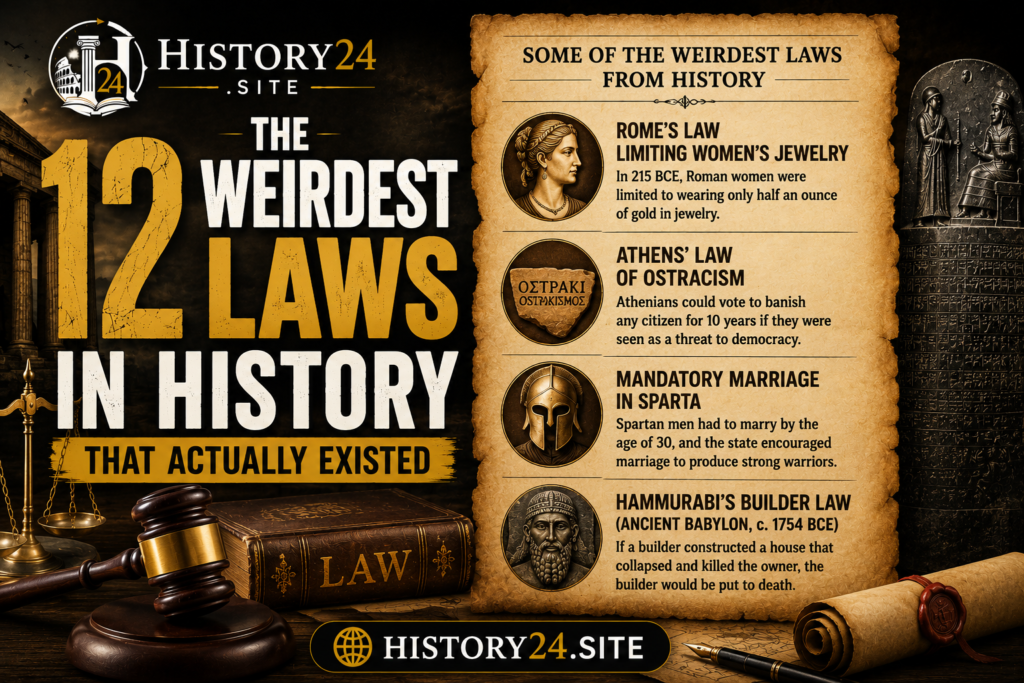
Laws are usually written to keep order, but throughout history, some rules pushed into territory that feels closer to satire than legislation. These 12 laws were real, enforced, and in some cases stayed on the books for centuries.
1. Hammurabi’s Builder Law (Ancient Babylon, c. 1754 BCE)
The Code of Hammurabi is famous for its “eye for an eye” style of justice, but one of its strangest provisions applied to construction. If a house collapsed and killed its owner, the builder responsible for constructing it would be put to death. If the collapse killed the owner’s son instead, the builder’s own son faced the same fate a legal principle that punished the builder’s family rather than the builder directly.
2. Mandatory Marriage in Sparta
Ancient Sparta placed enormous value on producing strong future soldiers, and its laws reflected that priority. Unmarried men past a certain age could face public humiliation, financial penalties, and even a loss of certain civic rights. Marriage wasn’t just encouraged in Spartan society, it was treated as a civic obligation.
3. Athens’ Law of Ostracism
In ancient Athens, citizens could vote once a year to exile a fellow citizen for ten years, without a trial or even a specific crime being named. The process, called ostracism, was originally designed to prevent any single person from gaining too much political power, but it effectively allowed a popularity contest to determine who got banished from the city.
4. Rome’s Law Limiting Women’s Jewelry
The Lex Oppia, passed in Rome in 215 BCE during the Second Punic War, restricted how much gold women could own and limited the colors and styles of clothing they could wear in public. It was originally justified as a wartime austerity measure, but women reportedly protested so strongly that the law was repealed about 20 years later, once the immediate crisis had passed.
5. Tudor England’s Clothing Laws
Under the sumptuary laws of Tudor England, what you were legally allowed to wear depended heavily on your social rank. Certain furs, fabrics, and colors, including specific shades of purple, were reserved strictly for royalty and nobility. Wearing the wrong fabric above your station could technically result in a fine.
6. Mandatory Archery Practice on Sundays
Under a law passed in 1541, English men were legally required to practice archery on Sundays and public holidays, while a wide range of other games, including bowls and card games, were banned outright for most of the population. The goal was to keep the country’s supply of skilled archers strong for military purposes, even as gunpowder weapons were beginning to make longbows less relevant on the battlefield.
7. The Royal Forest Laws of Norman England
After the Norman conquest in 1066, large sections of English forest were declared “royal forest,” where hunting deer or boar without permission became a crime, in some periods punishable by death or mutilation, regardless of whether the land had previously belonged to local villagers. The law prioritized the king’s hunting privileges over the land rights of ordinary people who had lived there for generations.
8. Victorian England’s Ban on Flying Kites in Public
Under the Metropolitan Police Act of 1839, it became illegal in London to fly a kite, slide on ice, or play any game likely to annoy other users of a public street. The law was aimed at reducing chaos and injuries in increasingly crowded city streets, but it’s remembered today mostly for how oddly specific its list of banned activities reads.
9. Britain’s “Red Flag Act”
The Locomotive Act of 1865, often nicknamed the “Red Flag Act,” required any self-propelled road vehicle in Britain to be preceded by a person on foot waving a red flag to warn oncoming traffic, while also capping vehicle speed at just 4 miles per hour outside towns. The law remained in place for over 30 years and is often cited as an early example of regulation struggling to keep up with new technology.
10. Massachusetts Banned Christmas Celebrations
In 1659, the Puritan-led Massachusetts Bay Colony passed a law banning the celebration of Christmas entirely, including feasting or taking a day off work, treating the holiday as an unauthorized religious observance rather than a biblical requirement. Anyone caught celebrating could be fined. The ban stayed in effect for over 20 years before being repealed in 1681.
11. Qin Dynasty China’s Punishment for Being Late
Under the strict legalist code of China’s Qin Dynasty, government-assigned laborers who arrived late to a mandated project could face severe punishment, with some accounts citing execution as a possible penalty depending on the delay and circumstances. The severity of these laws is often cited by historians as one of the contributing factors behind the rebellions that eventually toppled the dynasty.
12. England’s Medieval Ban on Football
In 1314, King Edward II issued a proclamation banning football in London, citing the public disorder and property damage caused by the large, rowdy street matches of the era, which bore little resemblance to the organized sport played today. Several English monarchs after him issued similar bans over the following two centuries, largely because the game kept pulling young men away from mandatory archery practice.
Final Thought
Every one of these laws made complete sense to the people who wrote them, shaped by the politics, technology, or anxieties of their era. Looking back, they’re a reminder that “common sense” has never stayed the same for very long and that today’s laws will probably look just as strange to someone centuries from now.
