The Zodiac Killer: California’s Most Notorious Unsolved Case

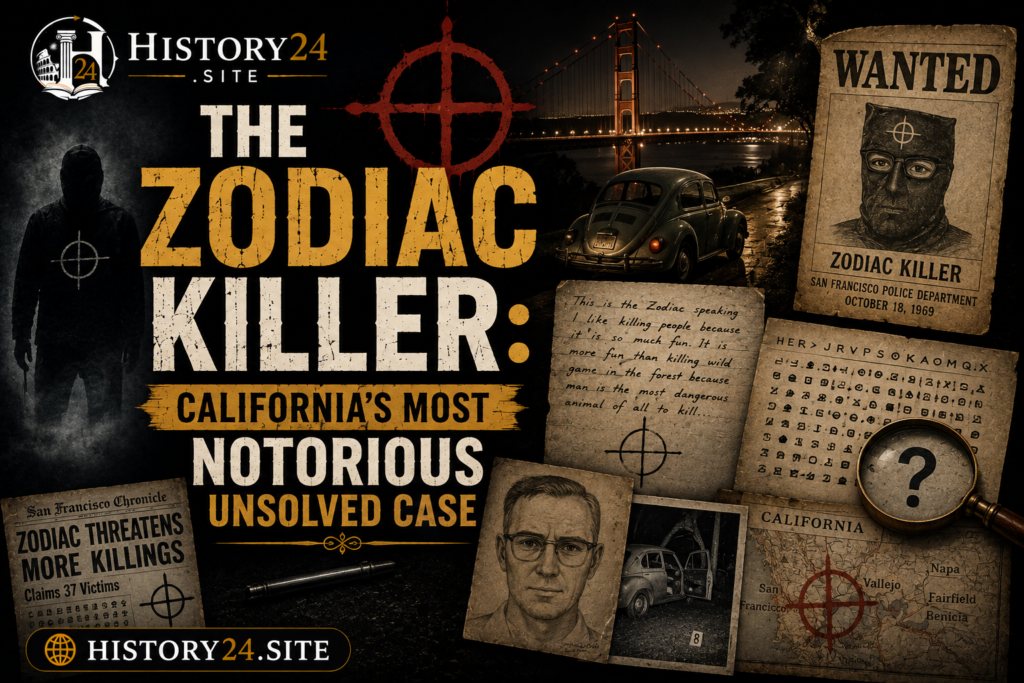
Between late 1968 and late 1969, someone in Northern California murdered at least five people, wounded two others who survived, and then spent years writing to newspapers, mocking police and the public in coded messages. He gave himself a name, the Zodiac, and never once slipped up enough to be caught. More than 50 years later, the case is still officially open.
The Attacks
The killings began on a rural road outside Vallejo, California, in December 1968, when two teenagers, David Faraday and Betty Lou Jensen, were shot and killed while parked in a car. Seven months later, in July 1969, another young couple, Darlene Ferrin and Michael Mageau, were shot at a lovers’ lane near Vallejo. Ferrin died at the scene; Mageau survived despite serious injuries and was able to describe his attacker to police.
The following September, at Lake Berryessa, the killer approached a couple having a picnic, this time wearing a hood with a symbol on it and claiming to be an escaped convict before binding and stabbing both victims. Cecelia Shepard later died from her wounds; Bryan Hartnell survived. A month after that, in October 1969, the killer shot and killed a San Francisco cab driver named Paul Stine, in what remains the only confirmed Zodiac murder to take place within city limits, rather than the more rural areas north of San Francisco Bay.
Investigators and researchers have proposed additional victims linked to the Zodiac over the years, but these five attacks are the ones law enforcement has formally connected to the case.
The Letters and the Ciphers
What set the Zodiac apart from other unidentified killers of the era was his direct communication with the press. Starting in the weeks after the Lake Herman Road and Blue Rock Springs attacks, letters began arriving at Bay Area newspapers, including the San Francisco Chronicle, describing details of the crimes that hadn’t been made public, which helped convince investigators the letters were genuine.
Several of these letters included encoded messages, known as ciphers, which the killer claimed would reveal his identity if solved. One of the earlier ciphers was cracked within days by a schoolteacher and his wife working independently of police, and it turned out to describe the killer’s stated motive rather than his identity. A second, longer cipher went unsolved for over 50 years, until a team of amateur codebreakers finally cracked it in December 2020 using modern analytical techniques. That message also didn’t name the killer, focusing instead on his lack of fear of being caught.
A handful of the killer’s other coded messages remain unsolved to this day, and it’s unclear whether they contain any further meaningful information or were designed largely to keep investigators and the public guessing.
Why the Case Was Never Solved
Part of what makes the Zodiac case so frustrating for investigators is that the killer operated across multiple jurisdictions, Vallejo, unincorporated Napa County, and the city of San Francisco, each with its own police department and evidence procedures at a time when departments shared information far less efficiently than they do today. Surviving witnesses, including Michael Mageau and Bryan Hartnell, provided descriptions of the attacker, but eyewitness accounts from a moment of extreme trauma are notoriously inconsistent, and no single composite sketch has ever led to a confirmed identification.
DNA testing has been attempted on some surviving physical evidence, including envelope seals from the letters, but results have been inconclusive or degraded, and no genetic profile has ever been definitively matched to a named suspect.
The Suspects
Arthur Leigh Allen became the case’s most prominent suspect after being named by an acquaintance in the early 1970s. He was investigated extensively over the following decades, including searches of his home, but was never charged before his death in 1992, and later DNA testing on available evidence reportedly failed to conclusively link him to the crimes.
Numerous other names have been proposed by researchers, amateur investigators, and journalists over the years, some backed by circumstantial handwriting or timeline arguments, none backed by evidence strong enough to secure an arrest. Some California police departments have periodically reopened aspects of the case as new forensic techniques become available, but as of now, no suspect has been officially confirmed as the Zodiac.
The Legacy
The Zodiac case reshaped how the public thinks about serial killers who seek attention, directly influencing decades of films, books, and true crime coverage. It also left a lasting mark on how police departments handle communication with active offenders, given how directly the killer used the press to control public perception of the case in real time.
Unlike cases eventually closed by a confession or a conviction, the Zodiac simply stopped, or at least stopped taking credit, sometime in the early 1970s. No trial. No named killer. Just a case file that’s stayed open longer than most of the detectives who originally worked it.
